Quran Study

The reading surface

How a page is built

One surah to a page, one verse to a card, and everything else layered over that.

What the page holds

Ten layers over one text. A verse can be nothing but Arabic, or everything at once.
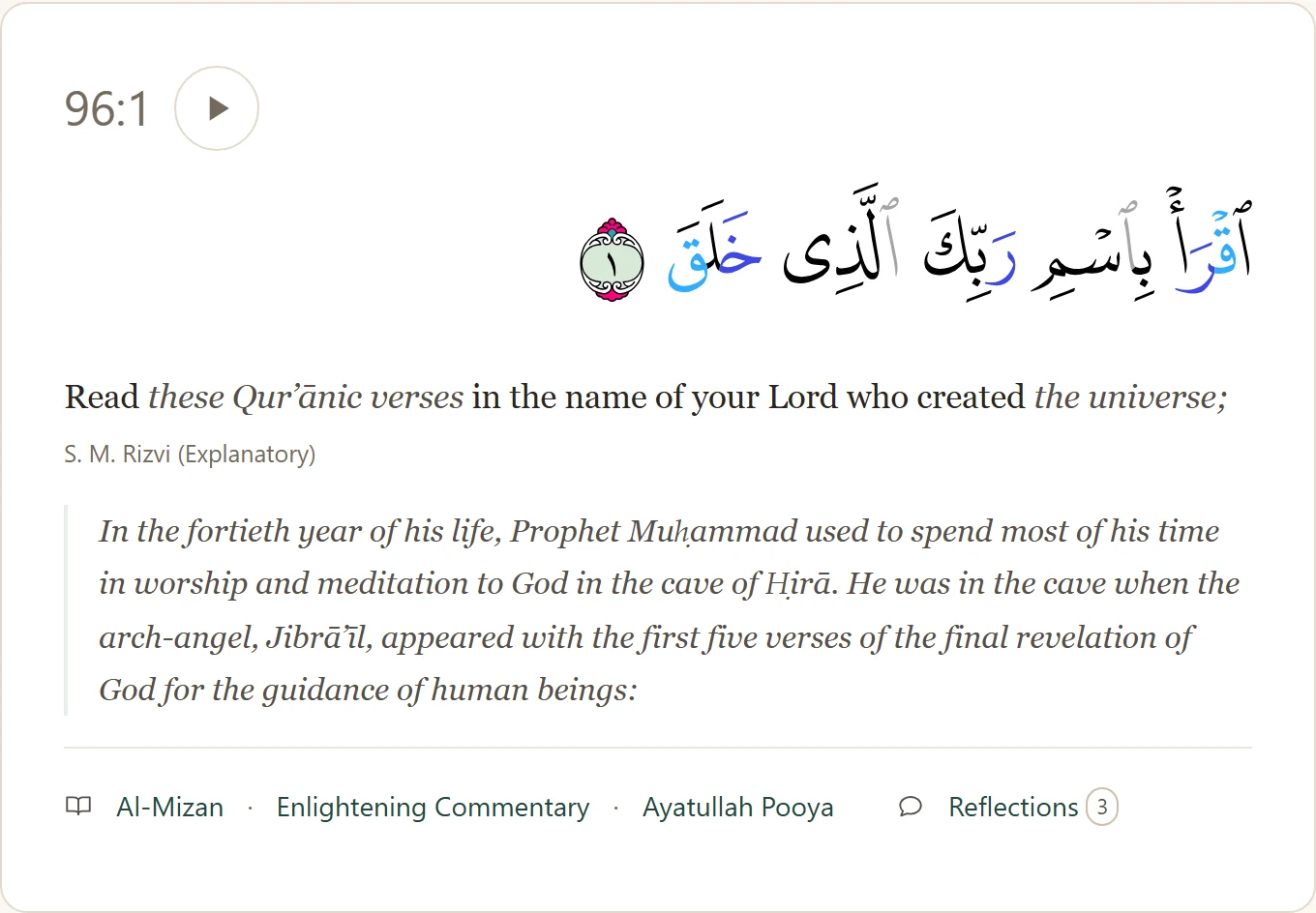
One verse card. At the top, 96:1 beside a round play button. Below it the
                  Arabic of the verse in the Uthmani mushaf, right to left, with several letters
                  coloured for tajweed and a decorated verse number at its end. Under the Arabic,
                  the line Read these Qur'anic verses in the name of your Lord who created the
                  universe, with the words supplied for sense in italics, credited to S. M. Rizvi
                  (Explanatory). Beneath that an indented note about the fortieth year of the
                  Prophet's life and the cave of Hira. At the foot, a row reading Al-Mizan,
                  Enlightening Commentary, Ayatullah Pooya, then Reflections with a 3 beside it.
96:1, as it opens.
  • A contextual translation

    Rizvi's explanatory reading, with every word supplied for sense set in italics.

  • Al-Mizan and the Enlightening Commentary

    Every verse, both of them. Beside the Qur'an, never in a new tab.

  • A second translation

    Ali Quli Qarai inline, and Saheeh International as a third.

  • Organised by topic

    Surahs gathered under the edition's own topic headings.

  • The Uthmani mushaf

    The printed mushaf's own script, coloured for tajweed, with a legend.

  • Word by word

    Tap a word: its meaning, its transliteration, and that one word recited.

  • Dictionary and grammar

    Behind that tap: the root, the grammar, every verse that uses it. Grammar from the Quranic Arabic Corpus, definitions from Lane.

  • Narrations that cite the verse

    Where a collection of the school of Ahl al-Bayt cites the verse by number. Each entry opens at Thaqalayn.

  • Commentary and footnotes

    Rizvi's commentary sits with the verse it explains; footnotes stay with their line.

  • Your setup, remembered

    Every layer toggles, and the page keeps your arrangement.

Display & Audio

Every switch the page has, behind one button. Nothing reloads.
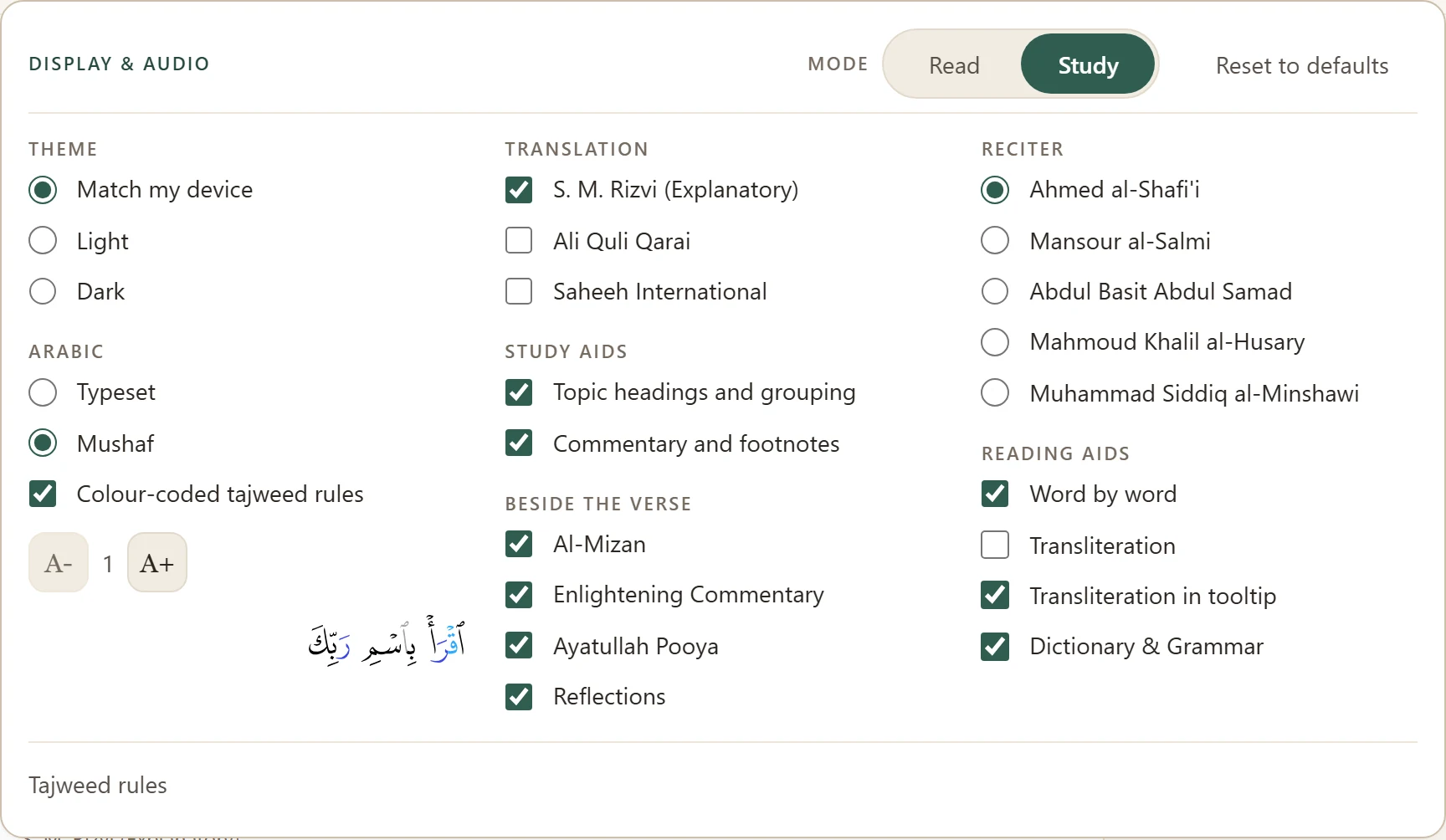
The Display and Audio panel. Across the top, its name, then Mode with Read and
                  Study as a pair of buttons and Study filled in, then Reset to defaults. Below, in
                  three columns: Theme, offering Match my device, Light and Dark; Arabic, offering
                  Typeset or Mushaf with Mushaf chosen, a checkbox for colour-coded tajweed rules,
                  a size control reading A-minus, 1, A-plus, and a specimen line of Arabic.
                  Translation, listing S. M. Rizvi (Explanatory) ticked, Ali Quli Qarai unticked and
                  Saheeh International unticked. Study aids, with topic headings and grouping, and
                  commentary and footnotes, both ticked. Beside the verse, with Al-Mizan,
                  Enlightening Commentary, Ayatullah Pooya and Reflections all ticked. Reciter,
                  listing Ahmed al-Shafi'i chosen, then Mansour al-Salmi, Abdul Basit Abdul Samad,
                  Mahmoud Khalil al-Husary and Muhammad Siddiq al-Minshawi. Reading aids, with word
                  by word ticked, transliteration unticked, transliteration in tooltip ticked and
                  Dictionary and Grammar ticked.
As it ships. Nothing is remembered until you move it.
Theme
Device, light, or dark.
Arabic
Mushaf or typeset, tajweed on or off, and size on a scale of its own.
Translation
Which of the three run under the verse. Each carries its own credit.
Study aids
Topic headings, notes, footnotes.
Beside the verse
Which sources get a button. Off clears the button, not the source.
Reciter
Which of five voices the play button uses. No preset moves it.
Reading aids
Word by word, and whether transliteration runs under the Arabic or waits in the tooltip. The dictionary follows it.

Read, and Study

Two buttons that move a handful of switches. Neither is a mode you are stuck in.

A small control labelled Mode, holding two buttons side by side in one rounded
                  track: Read, and Study, with Study filled in dark green.
The whole control, atop the Display panel.
Read
Arabic, tajweed, one translation. No notes, no headings, no buttons, no word by word, no dictionary. A surah to read start to finish.
Study
Notes, topic headings, the buttons under each verse, word by word, the dictionary behind it. Still one English column.
What neither one touches
Theme, Arabic face, size, reciter. Those are the reader, not a mode.

The commentary, beside the verse

A button under the verse opens the panel there, with a tab for each source.
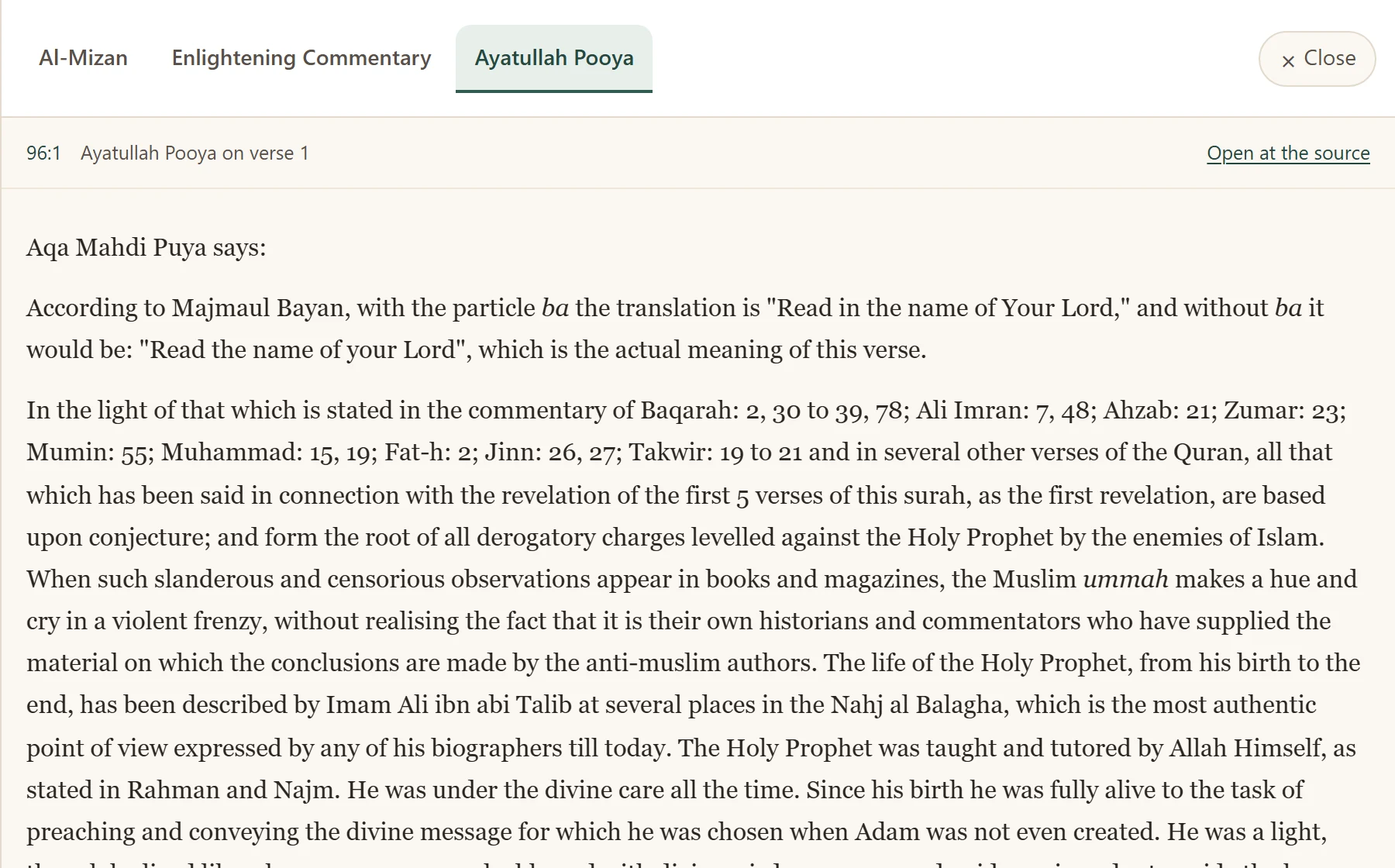
The top of the commentary panel. A row of three tabs, Al-Mizan, Enlightening
                  Commentary and Ayatullah Pooya, with Pooya selected and underlined, and a Close
                  button at the far end. Under the tabs a band reading 96:1, Ayatullah Pooya on
                  verse 1, with Open at the source at the right. Below that his commentary,
                  beginning Aqa Mahdi Puya says, and running on about the particle ba and the
                  translation of the verse.
One tab of three, at 96:1, the publisher's own page beside it.
Beside, never over
The reading moves aside, never under. Close the panel and you are back at full width, on the same verse.
On a phone and a tablet
The panel rises as a sheet, full width. Two columns that narrow cannot be read.
Each tab keeps its place
Each source stays where you left it. One with nothing on this verse says so.

The dictionary, beside the verse

The whole entry, where the commentaries open. Looking a word up never costs you the verse.
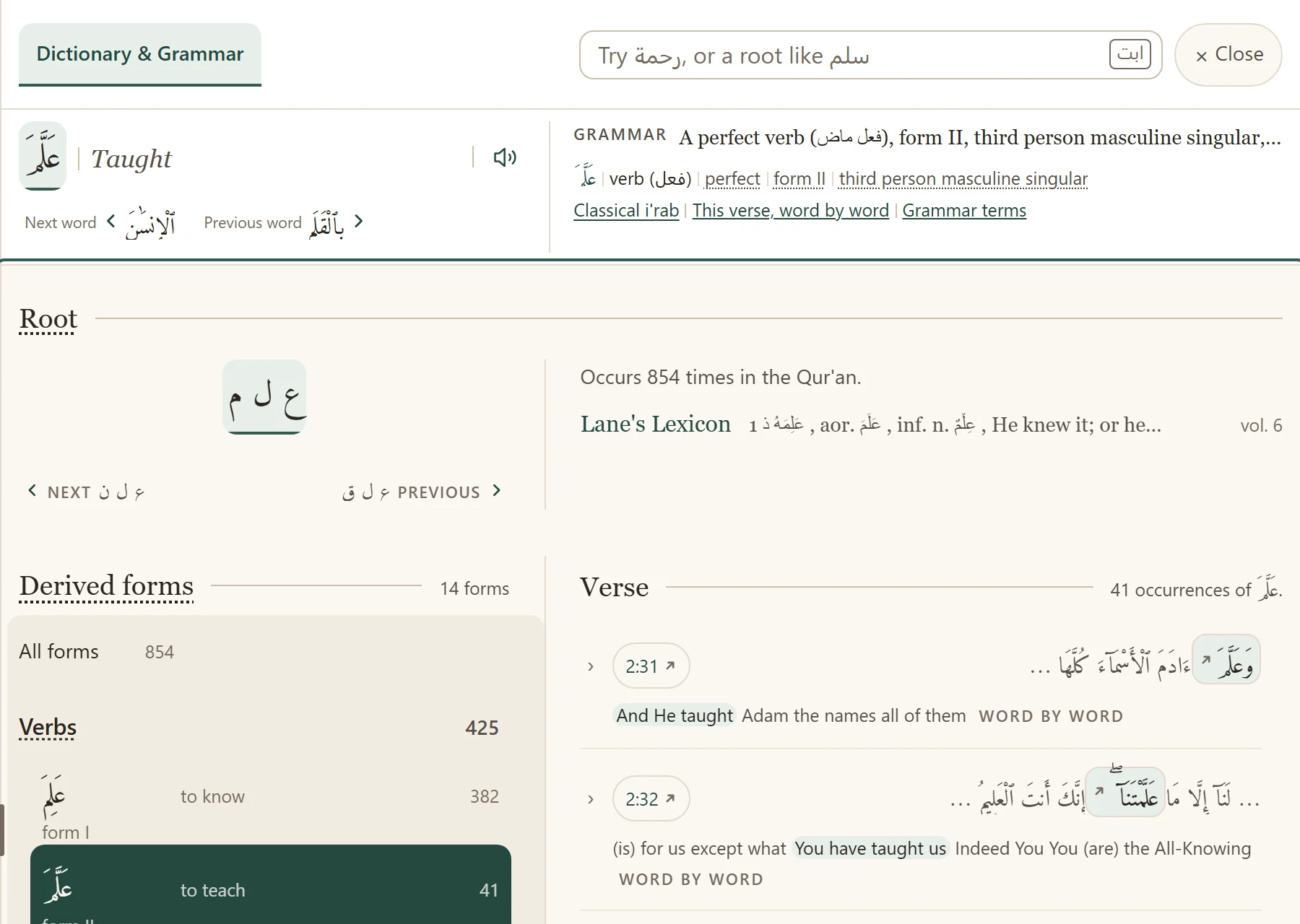
The Dictionary and Grammar panel. Across the top its name, a search box reading
                  Try rahma, or a root like salam with a small Arabic-script button inside it, and
                  Close. Below on the left the Arabic word 'allama in a tile, glossed Taught, with
                  a speaker icon, and Next word and Previous word beneath it. On the right, headed
                  Grammar, the sentence A perfect verb, form two, third person masculine singular,
                  then the word broken into segments with each grammatical term underlined, and
                  links reading Classical i'rab, This verse word by word, and Grammar terms. Under
                  a rule, a band headed Root showing the three letters 'ayn lam mim, the line Occurs
                  854 times in the Qur'an, the opening of Lane's Lexicon entry with its volume
                  number, and controls stepping to the next and previous root. Below that two
                  columns: on the left Derived forms, fourteen of them, listing All forms 854,
                  Verbs 425, to know 382 in form one, and to teach 41 in form two picked out in a
                  dark band; on the right Verse, 41 occurrences, listing 2:31 with the Arabic and
                  the reading And He taught Adam the names all of them, and 2:32 beneath it.
عَلَّمَ, taught, with the root it stands on underneath.
The word, and what it is doing
What it means here, that one word recited, and the grammar one line to a segment. Every term explains itself.
The root, and everything on it
Every word on the same root, grouped and counted. Choose one and its verses list beside it.
Where it all comes from
Grammar and roots from the Quranic Arabic Corpus; definitions from Lane's Lexicon, held here. Where Lane wrote nothing, the panel says so.

The narrations, beside the verse

A narration that cites a verse by number gives that verse an entry.
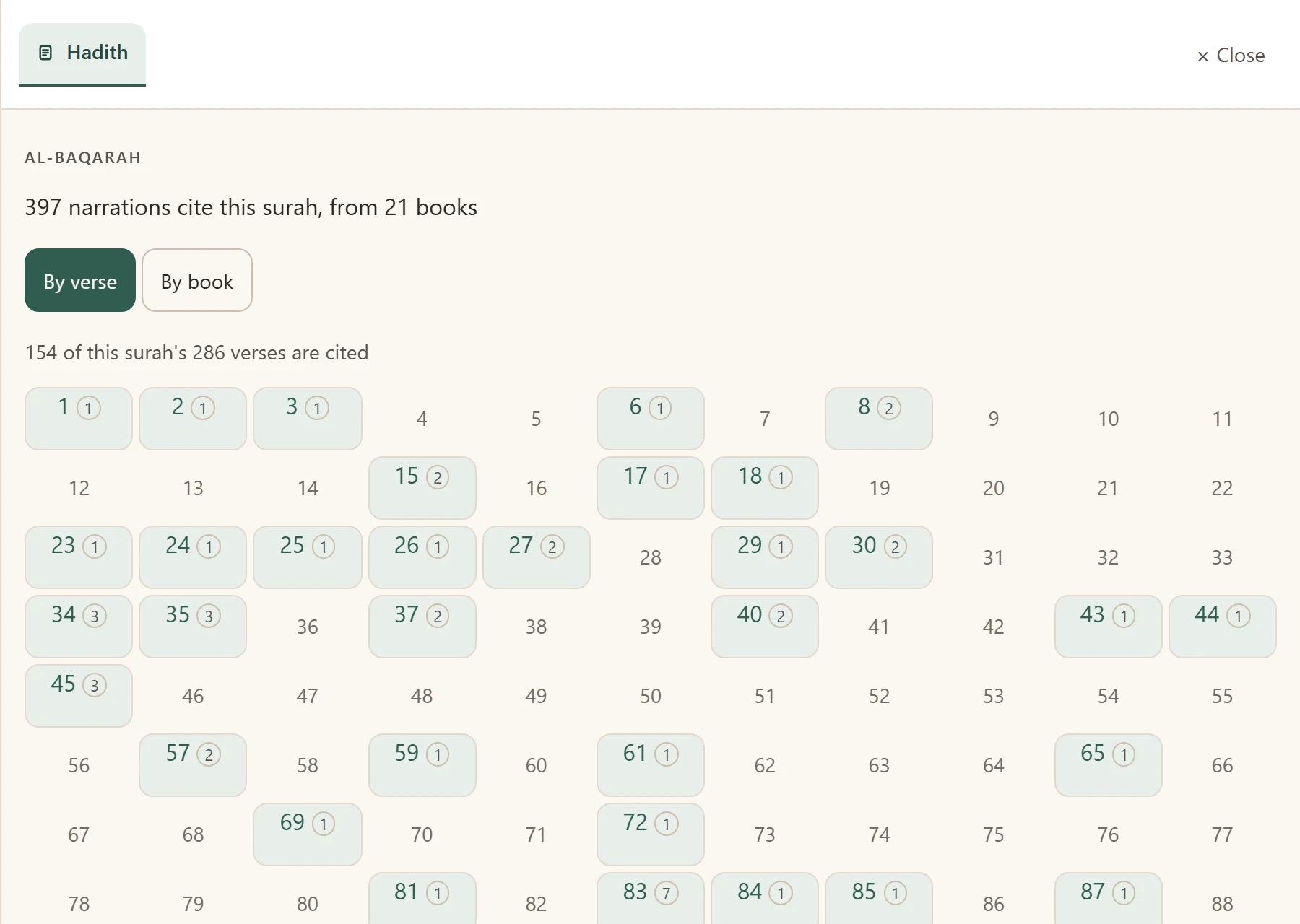
The Hadith panel. Its name at the top left and Close at the right. Below,
                  AL-BAQARAH, then the line 397 narrations cite this surah, from 21 books. Under
                  that two buttons, By verse and By book, with By verse filled in. Then the line
                  154 of this surah's 286 verses are cited, and a grid of verse numbers running
                  from 1 upward: numbers such as 1, 2, 3, 6, 8, 15, 17 and 18 sit in shaded rounded
                  chips each carrying a small count, while 4, 5, 7, 9 and their like stand as plain
                  unshaded numerals holding their places in the same grid.
Al-Baqarah by verse. Shaded numbers are cited and carry how many; the plain ones hold their places, so the gaps read as shape.
Two doors into one list
By verse maps the whole surah, speech and silence on one screen. By book groups them under their collection.
An explicit citation, and nothing looser
Only narrations whose translator printed a reference: 2,209 across 107 surahs, from 29 books. Matching wording would file one under the wrong verse.
Held by nobody here
A heading, a book, an address. Nothing is stored or framed here: every row opens at Thaqalayn (opens in a new tab), who publish the corpus. Every address is checked first.

Your own notes, beside the verse

Sign in and every verse gains a pen, next to the button that copies it.
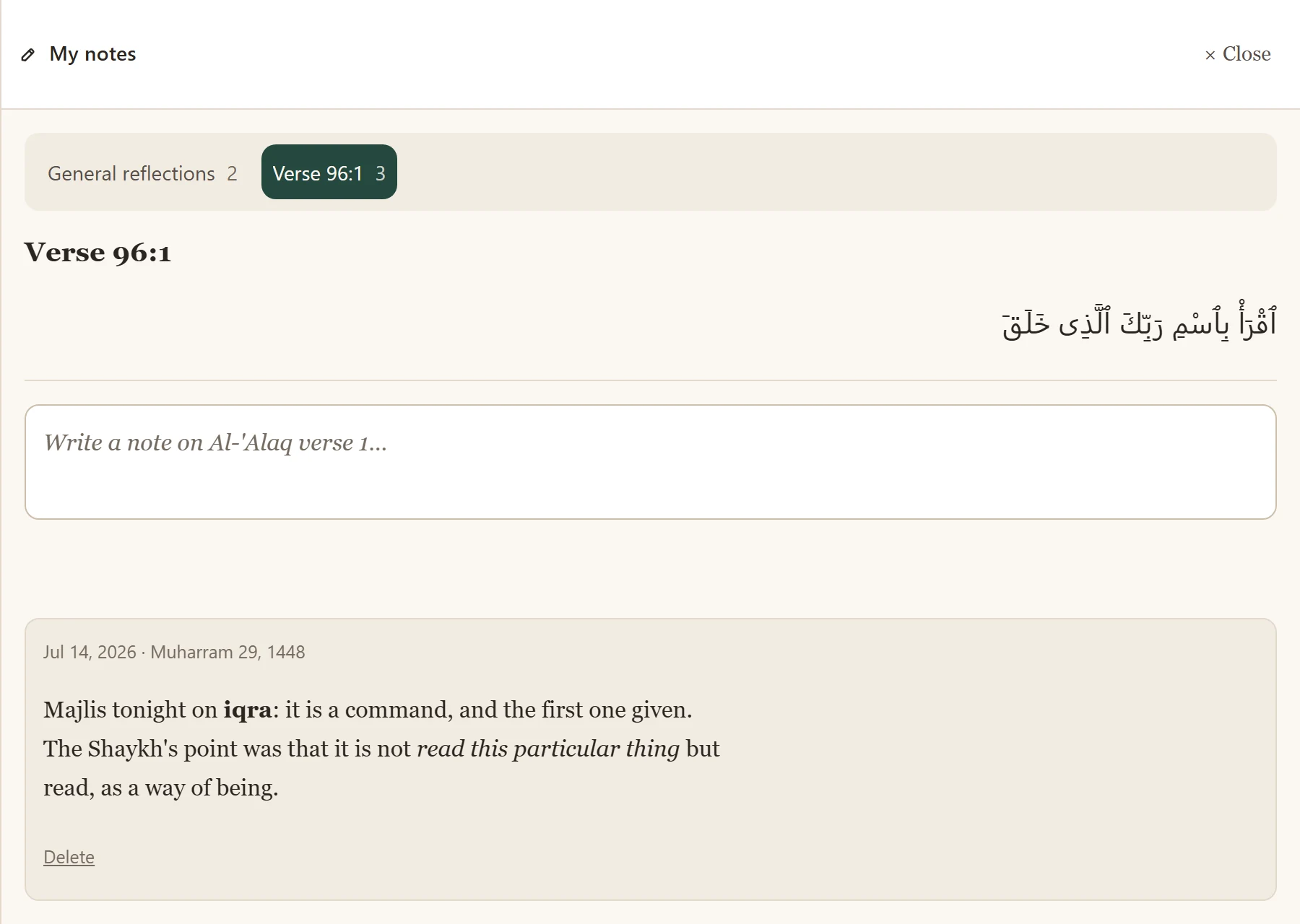
The top of the notes panel. A row reading My notes with a Close button at the
                  far end. Under it a recessed strip holding two tabs: General reflections with a
                  1, and Verse 96:1 with a 2, the second filled solid green with pale text. Below
                  the strip, the heading Verse 96:1 with the Arabic of that verse set to the right
                  of it, a rule, then an empty white box inviting a note on that verse. Under it
                  two dated notes, each on a card of its own in a muted sand colour -- each date
                  given twice, once in the ordinary calendar and once in the Hijri -- with a Delete
                  link under each. The second note is a bulleted list.
The panel at 96:1, with two sittings on the same verse.
A note, dated
On the verse, or on the surah as a whole. Write again a month later and both are kept, each with the day it was written.
Where you are reading
The panel opens beside the verse, where the commentaries open. On a phone it rises as a sheet, and what you have typed survives closing it.
One notebook, surah by surah
Everything you have written, gathered at /notebook, with the verse folded away beside your own words until you ask for it.

That is the whole of it. The rest is the reading.

Read Qur'an Now