Quran Study

In private preview

The best Qur'an resources, in one place.

Tajweed visible, the translation beneath, the commentary open beside it — each one click from the verse:

Everything else on the page

Read Qur'an Now How a page is built

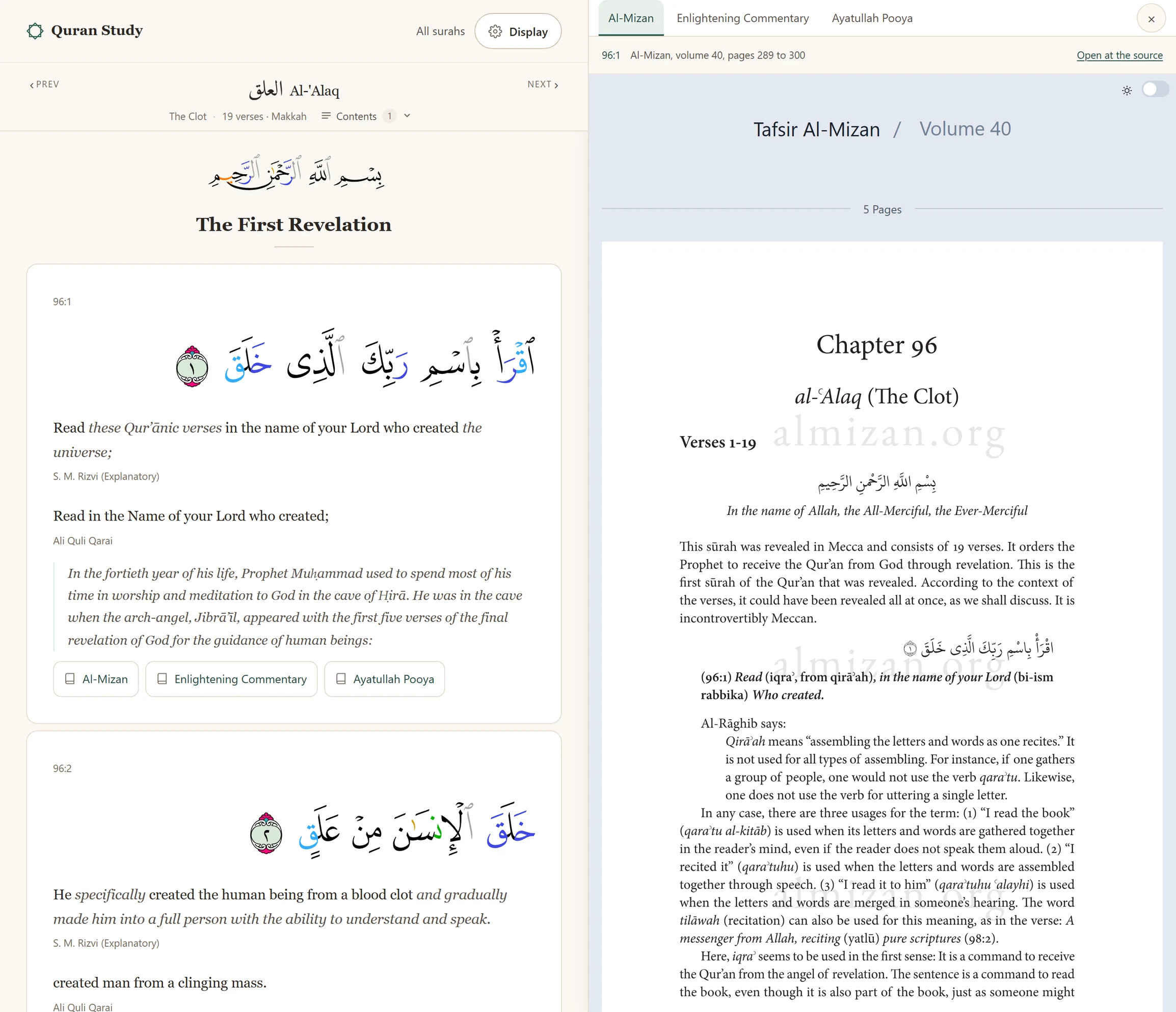
A desktop browser at quranstudy.app/quran/96, the window split down the middle.
                  Across the top of the left half: the Quran Study wordmark, an All surahs link and
                  a Display button, then a bar naming Sūrat al-ʿAlaq, The Clot, 19 verses,
                  Makkah, with a previous and a next arrow either side of it and a Topics
                  menu. Below that the bismillah, the heading The First Revelation, and verse 96:1
                  in the Uthmani mushaf with tajweed colouring, then the same verse in S. M.
                  Rizvi's explanatory translation and in Ali Quli Qarai's, a note on how the
                  revelation began, and three citation links: Al-Mizan, Enlightening Commentary and
                  Ayatullah Pooya. The right half is the commentary panel, with a tab for each of
                  those three and Al-Mizan selected, a line reading 96:1, Al-Mizan, volume 40, pages
                  289 to 300, a link to open at the source, and Al-Mizan's own reader open at
                  chapter 96.
A wide screen, unretouched: Sūrat al-ʿAlaq 96:1, with Al-Mizan open beside the verse — never over it.

One page, layered

96:1

اقْرَأْ بِاسْمِ رَبِّكَ الَّذِي خَلَقَ

Read these Qur’ānic verses in the name of your Lord who created the universe;S. M. Rizvi (Explanatory)

Read in the Name of your Lord who created;Ali Quli Qarai

In the fortieth year of his life, Prophet Muḥammad used to spend most of his time in worship and meditation to God in the cave of Ḥirā. He was in the cave when the arch-angel, Jibrā’īl, appeared with the first five verses of the final revelation of God for the guidance of human beings:

Al-Mizan Enlightening Commentary Ayatullah Pooya

One verse as the page draws it, 96:1, with every layer showing at once. The panel over the first word is drawn open; on the page it comes on a hover or a tap.

Dictionary & Grammar

Any word, all the way down.

Touch a word and its dictionary opens beside the verse: what it means here, what it is doing grammatically, the root it stands on, and everywhere else in the Qur'an that root is used.
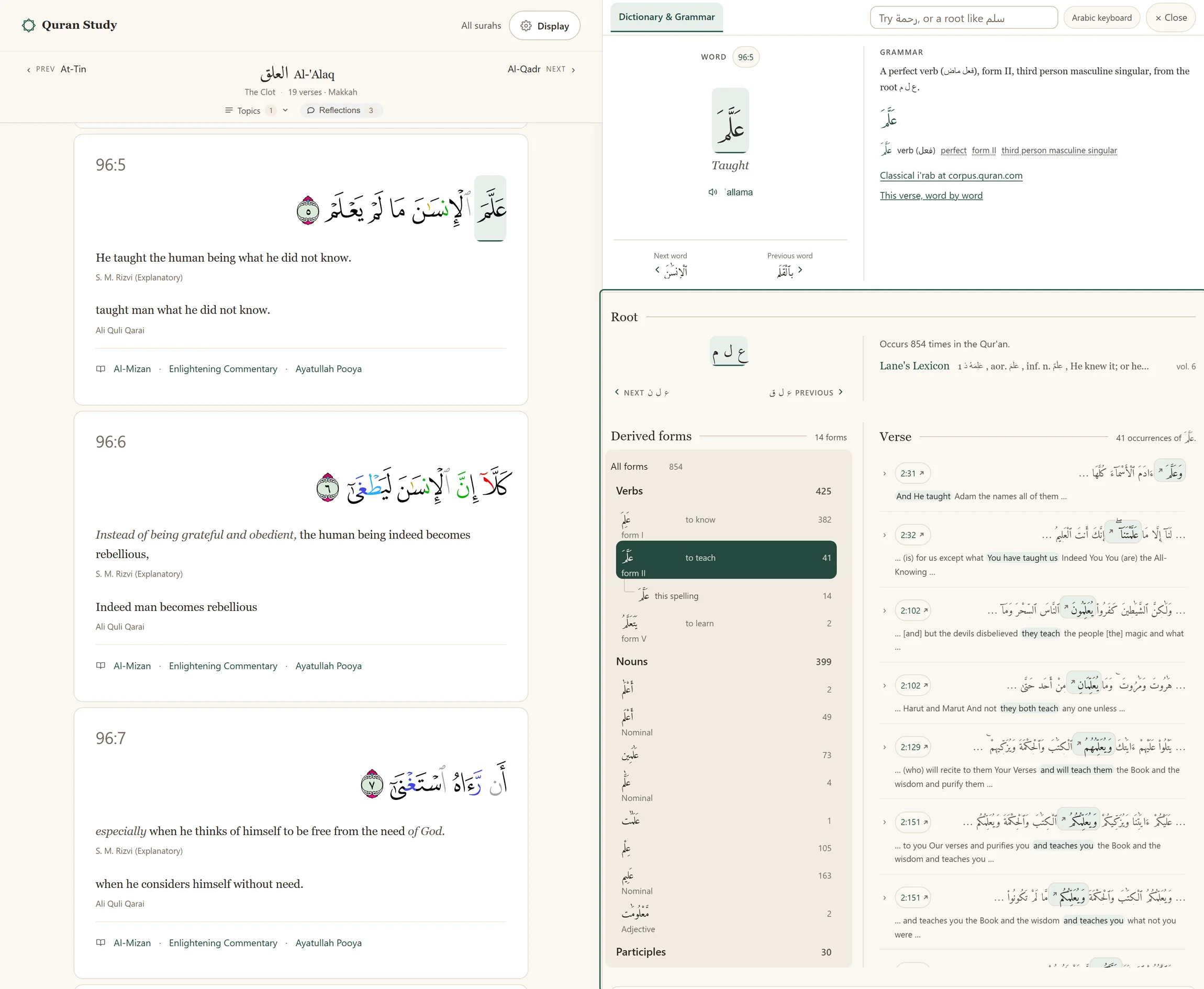
A desktop browser at quranstudy.app, the window split down the middle. On the
                  left, the Quran Study wordmark with All surahs and Display beside it, then a bar
                  naming Sūrat al-ʿAlaq, The Clot, 19 verses, Makkah, with Topics and
                  Reflections under it. Below that verse 96:5 in the Uthmani mushaf
                  with tajweed colouring, its first word
                  عَلَّمَ shaded to mark it as the word
                  being studied, then the verse in S. M. Rizvi's explanatory translation and in Ali
                  Quli Qarai's, and links to Al-Mizan, the Enlightening Commentary and Ayatullah
                  Pooya; verses 96:6 and 96:7 follow beneath. On the right, the Dictionary and Grammar panel: its name,
                  a search box, an Arabic keyboard button and Close across the top; then the same
                  word عَلَّمَ glossed Taught with the
                  transliteration ʿallama beside a speaker, and next to it, under Grammar, the
                  sentence A perfect verb, form II, third person masculine singular, from the root
                  ع ل م, with the word broken into segments and each grammatical
                  term underlined. Beneath, a band headed Root showing ع ل م
                  wearing the same mark as the word in the verse, the line Occurs 854 times in the
                  Qur'an, and the opening words of Lane's Lexicon entry
                  with its volume. At the foot, two columns: Derived forms on the left listing
                  fourteen entries under Verbs, Nouns and Participles with their counts and the
                  corpus's English
                  on the verbs -- to know, to teach, to learn -- with to teach selected; and Verse
                  on the right, headed 41 occurrences, listing 2:31, 2:32, 2:102 and the verses
                  after them, with the word
                  marked in each Arabic line and its English marked in the translation below.
Unretouched, with a word open in the dictionary: عَلَّمَ, taught, the first word of 96:5. The word is shaded in the verse on the left, heads the panel on the right, and is marked a third time on its radicals in the Root band, so the chain from the line to the root is visible at a glance. On a phone the panel rises as a sheet instead.
  • The root, and what stands on it عَلَّمَ rests on ع ل م, a root the Qur'an uses 854 times. The fourteen words built on it are grouped by kind, with the corpus's English where it gives one.
  • A menu beside its results Press any derived form and the verses beside it change to that form's own occurrences, each with the translator's English under it.
  • Grammar, segment by segment The word in one sentence, then its coloured decomposition, one line to a segment. Every term explains itself where it stands.
  • Lane's Lexicon, held here The classical entry for the root, on the page rather than a link away. Where Lane wrote nothing, the panel says so.

The morphology is the Quranic Arabic Corpus (opens in a new tab)'s own, credited on every word. Nothing here is invented: where a claim would have to be authored rather than cited, the panel says nothing at all.

My Qur'an Notebook

Write it down where you read it.

At a majlis or a lecture, open the verse being spoken about and write your note against it. Come back a month later and add another: both are kept, each with the day it was written, and the whole notebook reads back surah by surah.
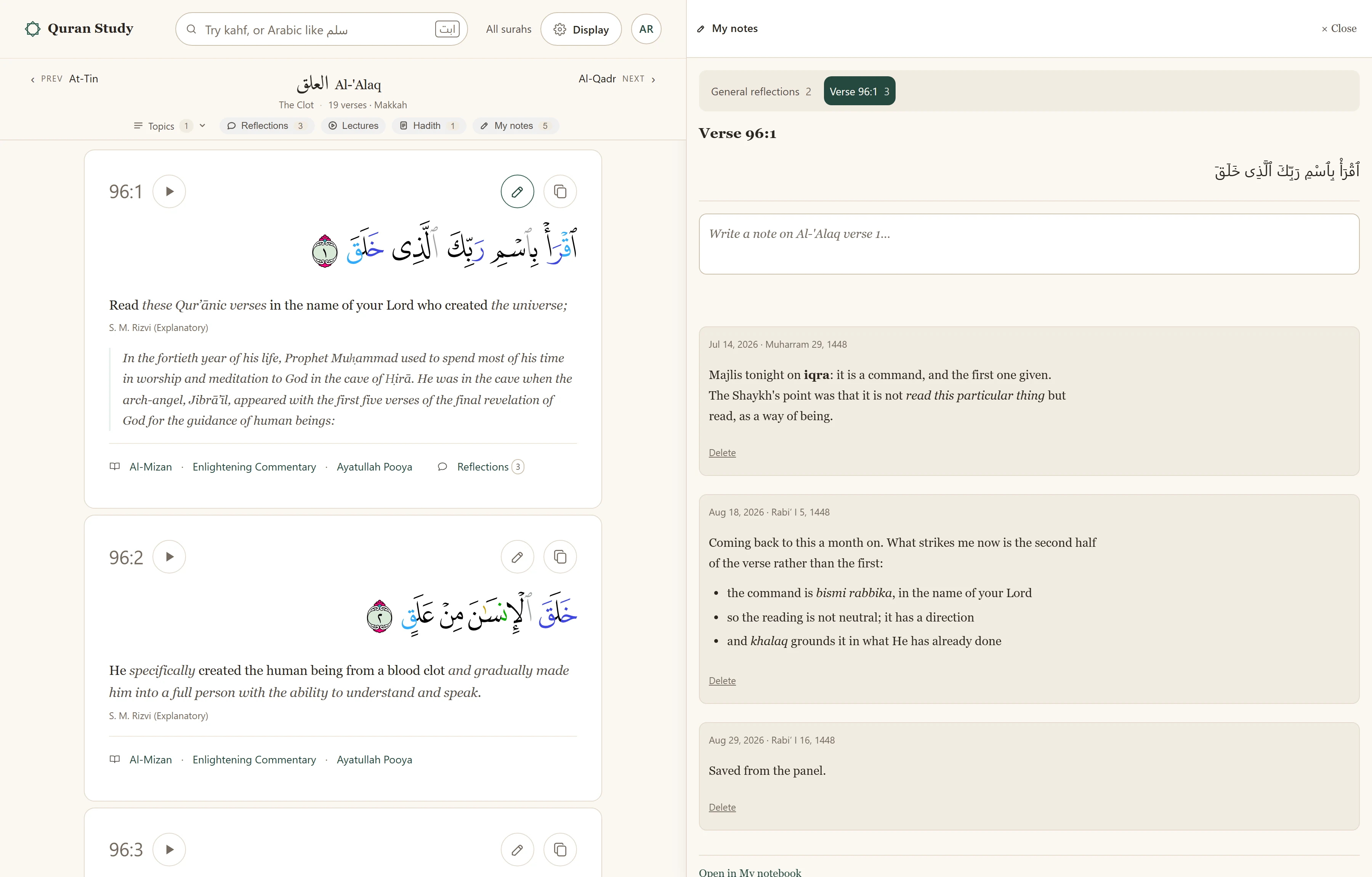
A desktop browser at quranstudy.app, the window split down the middle. On the
                  left, Sūrat al-ʿAlaq in Arabic with an English translation under each verse,
                  and at the right of verse 96:1's number line two round buttons, a pen and a
                  copy mark, the pen drawn in the darker green that says this verse has been
                  written on. On the right, a panel headed My notes with a Close button, and
                  under it a strip of two tabs reading General reflections with a 1, and Verse
                  96:1 with a 2, the second filled solid green. Below the strip the heading Verse
                  96:1 with the Arabic of that verse to its right, then an empty white box
                  inviting a note on that verse, and under it two dated notes, each on a card of
                  its own in a muted sand colour, headed by its date written twice -- once in the
                  ordinary calendar and once in the Hijri -- with a Delete link beneath. The first
                  mentions a majlis; the second is dated a month later and is a bulleted list.
Unretouched, with two sittings on one verse: the notes stand beside the reading rather than over it, and the verse they belong to is still there to be read. On a phone the panel rises as a sheet instead.
  • Two taps from the verse Every verse carries a pen beside its copy button. Nothing to navigate to first.
  • A log, not a page you overwrite Each sitting is its own dated entry. A verse you have returned to three times holds all three, in the order you wrote them.
  • On a verse, or on the whole surah Attach a note to the verse in front of you, or write a general reflection on the surah as a whole.
  • One notebook, read back A page per surah, your writing first and the verse folded away beside it until you ask for it. It reads on a phone on its own.

Notes are private to your account and are stored exactly as you typed them. They are shown to nobody else, and what an account holds is listed in full on the privacy page.

A note on access

The study space is in private preview while the rights to the translation are confirmed: it seemed right to settle that first. It is built and in daily use by a small circle of readers, and the invitation widens as soon as the permissions are in hand.